
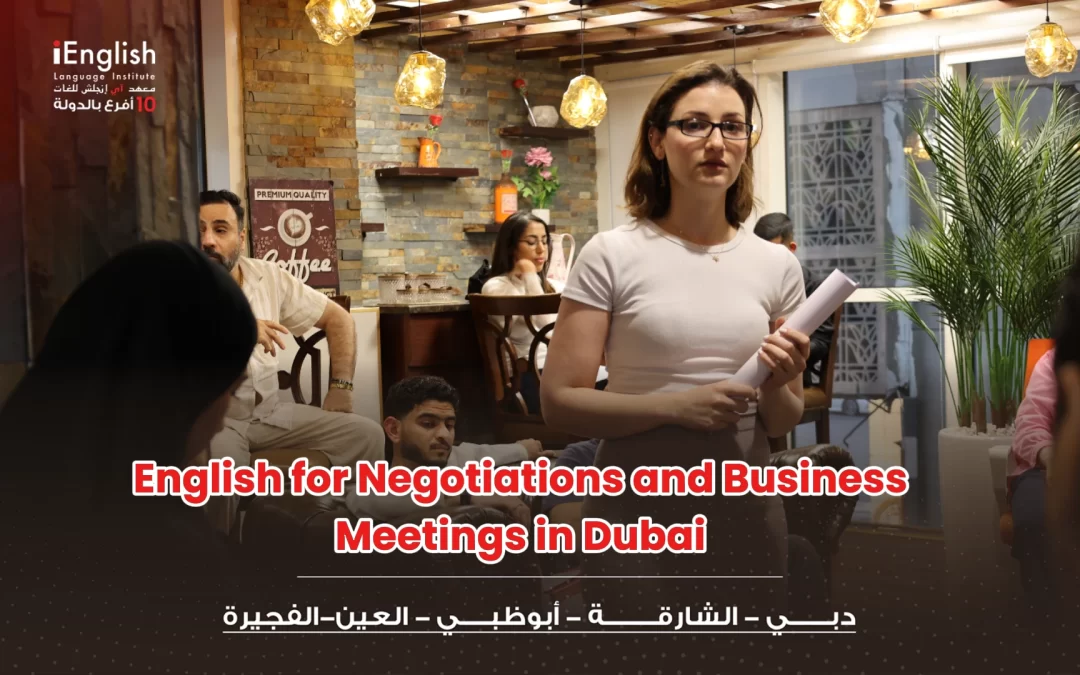
English for Negotiations and Business Meetings in Dubai
You know your industry inside out — but in a meeting room in Dubai, you hesitate before speaking, or you agree to terms because you couldn’t push back clearly in English. In a city where business runs across many nationalities, English for negotiations and business meetings is often what separates the person in the room from the person leading it. This guide covers the skills that matter most, real phrases you can use tomorrow, and how the Business English course at iEnglish Dubai builds them. We work with learners from all language backgrounds across the UAE.
Want to lead the meeting, not just attend it? Start with a level assessment
We assess your current English and build a plan around the meetings and negotiations you actually face at work.
Book a Level Assessment Call: 04 222 6757Why Meetings and Negotiations Are Harder in a Second Language
That’s why grammar lessons alone rarely help. What works is learning the specific language of meetings and negotiation, then rehearsing it until it becomes automatic.
The 6 Skills That Matter Most
Opening and setting the agenda
Starting a meeting clearly, stating its purpose and keeping it on track.
Presenting a proposal
Explaining your offer with structure: the problem, your solution, the benefit.
Disagreeing politely
Pushing back without damaging the relationship — essential in Dubai’s business culture.
Bargaining and conceding
Making conditional offers (“if you…, we can…”) and trading concessions instead of giving them away.
Clarifying and checking understanding
Asking the right questions so nothing is lost across accents and nationalities.
Summarising and closing
Confirming what was agreed and the next steps — then following up in writing.
Useful Phrases for Meetings and Negotiations
| Situation | Phrases you can use |
|---|---|
| Opening a meeting | “Thanks for joining. The aim today is to agree on…” · “Let’s start with…” |
| Presenting a proposal | “What we’re proposing is…” · “The main benefit for you would be…” |
| Disagreeing politely | “I see your point, but…” · “I’m not sure that would work for us because…” |
| Making a conditional offer | “If you can commit to…, we could…” · “We’d be open to that, provided that…” |
| Buying time | “Let me check that with my team and come back to you.” · “Can we park that for a moment?” |
| Clarifying | “Just to make sure I understand, you mean…?” · “Could you go over that last point again?” |
| Closing | “So, to summarise, we’ve agreed…” · “I’ll send a follow-up email with the next steps.” |
Knowing the phrases is step one. Using them naturally under pressure takes practice with feedback — which is exactly what the course is for.
Common Mistakes That Cost You in Negotiations
- Saying “yes” to fill silence — silence is a normal part of negotiating; agreeing too fast gives away value.
- Being too direct — “No, that’s wrong” can sound aggressive; softened disagreement keeps the deal alive.
- Not confirming numbers and dates — misunderstandings across accents are common; always summarise.
- Translating from your first language — idioms rarely carry over and can confuse the other side.
- Over-preparing a script — negotiations change fast; flexible phrases beat memorised speeches.
How the Business English Course at iEnglish Dubai Works
| Step | What happens |
|---|---|
| 1. Level assessment | We measure your speaking, listening and business vocabulary. |
| 2. Your goals | We map the meetings and negotiations you face — suppliers, clients, internal teams. |
| 3. Plan and cost | You get a clear schedule and full cost before you commit. |
| 4. Role-play practice | Realistic meeting and negotiation simulations in small groups, with correction. |
| 5. Real-world transfer | Follow-up emails, summaries and presentations based on your own work situations. |
Looking for broader speaking practice beyond negotiations? See our guide to the best English conversation course in Dubai for professionals.
Negotiate with confidence Start with iEnglish Dubai
Book a level assessment at Sheikh Zayed Road, Al Garhoud or online — and get a plan built around your real meetings.
Book a Level Assessment Find Your Branch